INTERNATIONAL EXPERIMENTAL

KIKI'S FILM | FILME DA KIKI
Estados Unidos da América | United States of America | 04’18’’ | 2018
Realizadora|Director: Gwendolyn Audrey Foster
Produção|Production: Gwendolyn Audrey Foster
Synopsis
Kiki’s Film is a dream poem for Kiki de Montparnasse, (Alice Prin); Artist, Muse, and creative partner of Man Ray. Kiki embodies the very essence of 1920's free queer sexuality and all things Dadaist and Surrealist. An interdisciplinary artist, Kiki was much more than a 'model.' Kiki was a painter, writer, nightclub singer, photographer, performance artist, memoirist and vibrant bohemian provocateur at the center of the Dada and Surrealist art scene in Paris, in the 1920s. Kiki looks directly at the viewer in this exercise in Objective Chance Surrealism (automatism); a dream occult homage; a look through Kiki's eyes in her imagined "lost film." You are no doubt familiar with Kiki's image, as she appears in many famous Surrealist films and photographs, including Man Ray's Le Violon D'Ingres, but Kiki was far more than a model or a Muse. Kiki was a performance artist before performance art. By the late 1920s, Kiki had her own cabaret, Chez Kiki, She had also begun painting primitives and, in 1927, had a sell-out exhibition. Her memoir, The Education of a French Model, was banned in America. The more I read about Kiki, the more I fall in love with Alice Prin.
Biography
Gwendolyn Audrey Foster is a filmmaker, artist, author, and curator. She creates handmade experimental films in small gauge (Super 8mm, 16mm) and détournements from archival 35mm archival film. Foster is Willa Cather Professor Emerita in Film, Women's & LGBTQ+ Studies at University of Nebraska and author of many books such as Experimental Cinema, Women Filmmakers, Disruptive Feminisms, and Identity and Memory: The Films of Chantal Akerman. Foster’s documentary on early women filmmakers, The Women Who Made the Movies, is distributed internationally by Women Make Movies, in NY. Foster’s films have screened at Anthology Film Archives (NYC), Museum of Modern Art (MoMA, NY), Outfest (LA), Bi+ Arts Fest (Toronto), National Museum of Women in the Arts (DC), Films de Femmes (Créteil), Alchemy Film Festival(Scotland), CODEC (Mexico), MO Museum (Lithuania), Filmhuis Cavia (Amsterdam) and many other art galleries, museums and film festivals around the world. Her work is archived at the UCLA Film & Television Archives and at the Museum of Modern Art.

MY FIRST 100 DAYS | MEUS PRIMEIROS 100 DIAS
Argentina | Argentina |02’00’’ | 2020
Realizadora|Director: Florencia Silva García
Produção|Production: Florencia Silva García
Synopsis
This video was made during the quarantine inside my house; In it, I collected the different self-portrait photographs that I took during the pandemic. The montage was organic as I did not move any of the photographs from their place.
Biography
My name is Florencia, I am an audiovisual communicator and educator. Currently I am dedicated to recording wedding videos and teaching. Once a year, I make an experimental video, at least so far it has been like that, including the shorts New York with Iphone and Twin Reflection.

PORTADORAS QUEER: EL DOBLE Y LA REPETICIÓN | PORTADORAS QUEER: O DUPLO E A REPETIÇÃO
Espanha | Spain |15’39’’ | 2020
Realizadora|Director: Ana Laura Aláez
Produção|Production: Ana Laura Aláez
Synopsis
With Portadoras queer: el doble y la repetición, Aláez explores the degrees of rebelliousness in a given representation of plural femaleness via the use of image repetition in parallel with musical repetition. The video is based on a specific track produced in partnership with the electronic music project of the German musician Daniel Holc / Ascii.Disko. We could say it is a music video upside down with the image done first and the music produced afterwards. The refrain “I can’t get away from myself” is like the script. The main structure comprises various chapters with several performances and narratives that arise in the making. A non ending short film that could be everything at the same time: a drawing, dance performance, art performance, music video, a visual diary. The most important is that all the characters are carriers of no binary identities in perpetual motion. Each one is like a contemporary demiurge: in search of a personal form of expression no matter how many times they fall down constructing themselves.
Biografia:
Do País Basco, Ana Laura Aláez é uma das mais reconhecidas artistas contemporâneas espanholas. Ela foi convidada a contribuir para o Pavilhão da Espanha na 49ª Bienal de Veneza, 2001. Seus primeiros trabalhos denotam uma assimilação gradativa das questões exploradas pela geração anterior, os expoentes da “Nova Escultura Basca”, mas também introduziram elementos corretivos relacionados à perspectiva de gênero, usando estratégias baseadas em processos e materiais não tradicionalmente considerados esculturais, como vídeos e música.

REPEAT | REPITA
Alemanha | Germany | 02’33’’ | 2021
Realizadora|Director: Ingrid Gans
Elenco|Cast: Susanne Golnick
Produção|Production: Ingrid Gans
Synopsis
Experimental filmic examination of the feminist-spiritual poetry of Luisa Francia.
Biography
Currently Lives and works in Flensburg and Lower Franconia. Artistic work in the disciplines of painting, metal objects, (animated) film. Social Pedagogue, feminist, cultural worker.
SEE AGAIN |REVER
França/Brasil | France/Brazil | 03'22"| 2020
Realizadora|Director: Raquel Gandra
Elenco|Cast: Joyce Lainé, Raquel Gandra
Produção|Production: MTK Labs, Hernani Heffner, Raquel Gandra
Synopsis
Rever as in seeing for a second time (Portuguese), provided with the prefix of repetition, but also as in dreaming (French), close to the English word reverie as in daydreaming. This palindrome title invites us to see things for the first time, with fresh eyes, and to see them from beginning to end and from end to the beginning. To bring rhythm and ritual to the apparently meaningless and useless gestures so that we can resignify our presence in the landscape and in the image itself.
Biography
Raquel Gandra is a Brazilian visual artist, filmmaker and wanderer. Much more inclined towards a poetic approach, she seeks to create images that would, otherwise, not be seen. Porous and wavering images, that take place between materiality and its transposition, and don’t aim to translate the world, but dare to imagine it. Her work doesn't restrain to one medium or one format, whether it be video or photography, film or digital, document, or fiction. The exploration of various analog techniques as a frequent approach comes from the desire to include chance as an inherent part of the process, understanding the image-making device as a place of unveiling and unfolding, conducive to questioning the way we see and perceive reality itself.
SYMPOIETIC BODIES | CORPOS SIMPÓTICOS
Áustria | Austria | 11'12" | 2020
Realizadora|Director: Flavia Mazzanti
Elenco|Cast: Cat Jimenez, Elisa Elektra Pirone
Produção|Production: Flavia Mazzanti
Synopsis
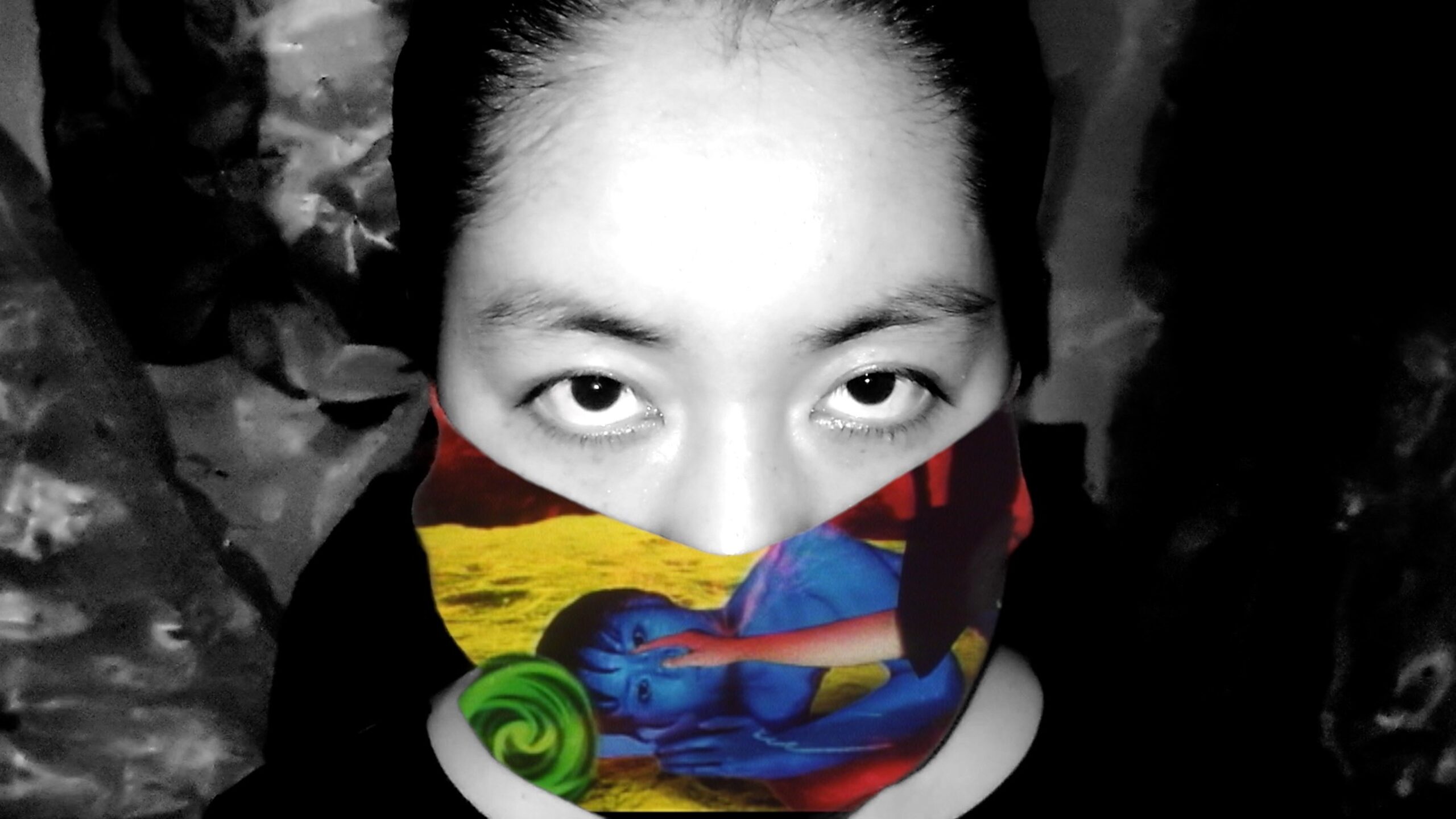
The hybrid short film Sympoietic Bodies explores the disruption of the boundaries between human body and its social and physical surroundings. The short film arises from the interest in combining a philosophical understanding of our bodies and their interaction with other beings in and within the constructed environment, with the exploration of new technological possibilities in the experimental and animation film context. Everything which is shown in the film comes from the physical world and has been further manipulated in animation software. Each different technology has been used with the purpose of exploring a different point of view of the world we inhabit. Animation is here used as a sociopolitical tool, where the hybrid use of computer-generated animations and digital shootings aim to provide different perspectives on ourselves and our environment, while creating a continuous interplay between an anthropocentric and a post-anthropocentric point of view. In this sense, the film experiments a postanthropocentric scenario related to a nowadays society, where the human body gets decentered and deconstructed in its whole. The plot shows glimpse of the life of “C”, inhabitant of an urban configuration, and details of her interaction and perception within the urban environment.
Biography
Flavia Mazzanti is an Italian Brazilian media artist, architect and researcher based in Vienna, Austria. She graduated with distinction at the Academy of Fine Arts Vienna, receiving the Gustav Peichl Award and the Würdigungspreis for artistic work for her master thesis project. Flavia’s work focuses on post- anthropocentric relationships between bodies, environments and societies, ranging from architectural- philosophical theories to media art and experimental filmmaking. She was recently awarded with the Artist- in-Residence Program “Pixel, Bytes + Film” for media arts from ORF III - Kultur und Information (Austrian Broadcasting Corporation) and BMKÖS (the Federal Ministry for Arts, Culture, the Civil Service and Sport) for her hybrid short film Sympoietic Bodies (2020). Her work has been screened and awarded at festivals in Europe, Oceania, North and South America.

XX-20
Rússia - Russia | 24'05"| 2020
Realizadora|Director: Elena Skripkina
Elenco|Cast: Anna Yudakova, Muslim Osmonov, Ilya Nikulin, Anna Khlestkina, Darina
Taratina, Maria Beatty, Natalia Pakhomova, Maria Nalimova, Lyudmila
Strekaleva, Gennady Mironovich, Pavel Kravets, Ilya Harlanov, Alexandra Krasko
Produção|Production: Andrey Silvestrov, Kirill Adibekov
Synopsis
The film XX-20 is a kaddish that invites us to rethink the catastrophes of the 20th century through a perspective of the Event. It reveals itself in front of an empty grave and takes on a different meaning, and thus an eschatological responsibility for it. Hiroshima, the siege of Leningrad, Gulag: these three disasters associated with modern reality carry in them a genetic memory and interconnect in a single number XX020.
Biography
Graduated from VGIK course on the making of non-fiction films, Elena Skripkina then obtained a master degree in theology, and is currently writing a dissertation on the subject of "Eschatology in the culture of the 20th century". She is also making sculpture and music pieces. Filmography: Black-and-White Fish (2005), prize for "Poetic implementation of reality in cinema", St. Ann Festival 2006; Future Shots International short movie festival 2006, prize on Prague Festival KoloritFest and an opportunity to participate in international film almanac devoted to russian language culture (organized by EU) in 2013; Moksha (2005), Audience Award on International Film Festival of Gerasimov All-Russian State Institute of Cinematography; Letters to Felicia (2006), Video Installation for the Prague Franz Kafka Museum; Deep, very deep (2013), story film; 12 Letters for a Friend Who Disappeared (2013), documentary; Lighthouse. Six Letters about One Encounter (2015), documentary.

