
“RETHINKING THE (IN)VISIBLE LABOUR OF CARE IN FILM ARCHIVES AND WOMEN’S FILM HERITAGE”
Day: 20 April
Time: 5:30 P.M.
Venue: Casa Comum
Efforts to rethink film archives remain incomplete and urgently require critical assessment, especially regarding the ways in which women’s work in cinema has been historically marginalized. Films made by women — particularly by creators from the Global South, Eastern Europe, and the Balkans — are often excluded from official archives and canonization processes, with their legacy preserved through personal rather than institutional efforts. This reflects a broader pattern in which women’s work is treated as peripheral and contingent, instead of being recognized as an integral part of a shared cultural and historical heritage.
The history of cinema has long privileged masculine, Western, and elite forms of work, neglecting the contributions of women. This negligence is not ‘benign’, but structurally harmful, as it contributes to the systematic erasure of recognition of women’s creative and intellectual work. The problem is even more pronounced in the Global South and in the contexts of Eastern Europe and the Balkans, where patriarchal, colonial, and Eurocentric structures have further obscured and devalued women’s work. The two films selected for this session — Fatma 1975 and Braille’s Alphabet — function as case studies of these exclusionary practices. At the same time, their recent digitization and restoration processes demonstrate how the collective work of archivists, filmmakers, researchers, and curators can help bring visibility to works and authors previously neglected and marginalized. This creative work continues, to a large extent, to be carried out by women, in specialized contexts such as archives, film festivals, and academia, constituting gestures of care toward the invisible and forgotten cinematic legacies from different parts of the world.
This slow, repetitive, and meticulous work with and within archives and archival collections seeks to recover women’s ‘herstories’ erased from the history of cinema, largely due to the predominance of an auteur‑centered theory that tends to privilege individual creators, often men. Instead, as Jane Gaines argues, it is necessary to shift the focus toward production processes, collaboration, and collective work. In this sense, Lauren Rabinowitz warns of the risk of assuming a single, homogeneous female perspective, arguing that a feminist history of cinema must be grounded in archival, social, and historical research. We consider that rewriting the history of cinema is a radical act of labor, one that highlights the importance of care as a central dimension of a feminist and activist approach. It implies expanding the concept of the archive to include forms of labor frequently neglected — in particular those of women, of working‑class communities, and of non‑Western filmmakers — and recognizing that feminist cinema emerges in diverse contexts. Ultimately, our book and our curatorial work propose a redefinition of the modes and the places where feminist cinematic labor is recognized, valued, and preserved, in order to counteract its continued marginalization.
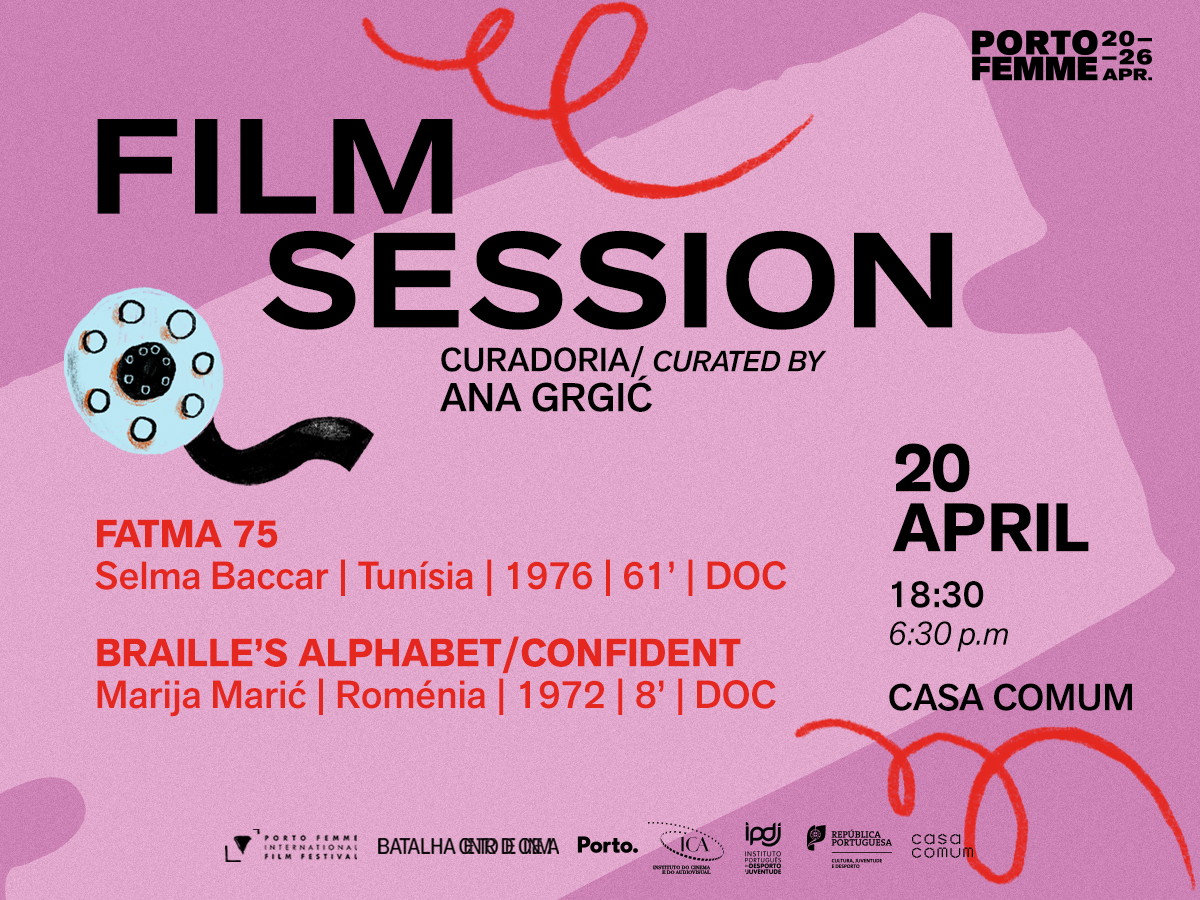
| Film Session |
The second part of the special session conducted by Ana Grgić brings to our screens two films from the 1970s that construct a portrait of the society of that time through a female lens!
“We invite everyone to join us for this session on April 20, at 6:30 p.m., at Casa Comum.
| PROGRAM |
- Fatma 1975 by Selma Baccar | Tunisia | 1975 | 60’ | doc
- Braille’s Alphabet by Marija Marić | Romania | 1972 | 8’| doc

