Anabela Moreira
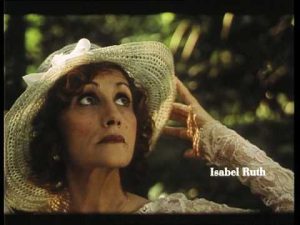
THE SILENCES OF ISABEL RUTH
Silences gave birth to cinema – which has never been mute – because silences that run through our cinematographic imagination have always been blatant, always intense and always mysterious.
Silences in film let us go through spaces, apprehend gestures and live emotions. And they build covenants of complicity. Complicities that bind us to the chair, leave us to think and inevitably push us into a world of illusions… or not!
In the silences of film, there are always gazes that guide and dominate everything. I chose the gaze of directors Paulo Rocha, João Botelho, Manoel de Oliveira and Sérgio Tréfaut to build my gaze on Isabel Ruth.
In the characters she plays, in the narrative journey that leads them and in the words she pronounces to give them body, I chose the silences of Isabel Ruth.
I chose the silence of a dancer’s body, the lightness of a diffuse body that dances metamorphosed over fire and water when she is the Mad American of Lucius’ confession in Conversa Acabada by João Botelho.
I chose Marta’s intense and striking look, in the picture about the Piano, that Diva’s look, static, in contrast with the diaphanous and intense body, but at the same time, challenging and demanding, that dominates that picnic, of Inquietude, in Manoel de Oliveira. And Isabel Ruth’s eyes seek Oliveira’s camera, in silence.
I chose the hard look of an unsympathetic maid who holds the umbrella and protects a shy photographer called to record a death course in Manoel de Oliveira’s O Estranho Caso de Angélica. She is just a maid, in uniform, with a hard look. But that hard look is always there. It is the maid that leads us to a narrative universe that, apparently, is not part of the original script. She is perhaps the only character who knows what is going on with Isaac. And she tells us all that… through the silences. And he tells us all that through a dancer’s body, through some feet that dance when he runs to deliver the envelope to Isaac.

I chose the quick but significant presence of a milk vendor, a character in a film that moves before the eyes of a director who also plays and conquers through the silences (played by John Malkovich). Here, Isabel Ruth is a milkmaid of Vermeer, looked at, in a process of speculative discourse. A quick appearance, a single camera gaze, an afflicted gaze… but which enters into the intensity of Malkovich’s gaze, in Manoel de Oliveira’s Vou para Casa.
I chose Albertina’s body and gestures, in Mudar de Vida, by Paulo Rocha. Isabel Ruth is a body that runs, that hides itself, that observes, as if in a ballet, gestures that are diaphanous but that steal the alms box and run rampant through the pine forests. I chose the intense strength of a mysterious woman, demanding, with a look of hatred, of defence and of wild independence. Albertina identifies herself in the dialogues but she becomes unique through the speed of her gestures, the haughtiness of her gaze, and the fighting spirit mirrored in the way she hides in the pine forests.
I chose the Ilda that Paulo Rocha chose for the Os Verdes Anos. Ilda is determined, a fighter, energetic before everything and, once again, the intensity of a dancer’s body, a body that runs as if it were dancing, a body that imposes itself in the architectural magnificence of the new avenues. Because it is a body and the silence of what the director wanted to transmit to us.
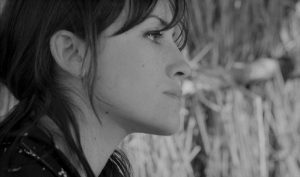
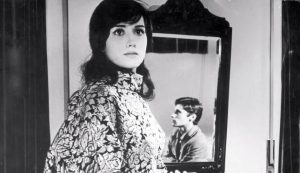
I chose the silences of a maid who, in an attitude of servility and humility, projects all the dramatic intensity of a film: Celsa from Manoel de Oliveira’s O Princípio da Incerteza. Celsa observes her master intensely, with a servility and infinite tenderness. She is omnipresent in all the dinners of the farm, hidden from the diners but in the centre of all the plans chosen by Oliveira. It is the silent face of the wonderful and intense train travellings through the Douro river. Celsa’s silences hide the intensity of a secret that defines the whole narrative process of the film. Celsa looks at the photos, cleans the dust, kneels down and looks at a portrait of the Virgin Mary and, in her silences, everything is felt.
In the path of the silences entrenched in the characters that speak, I chose a mute character. Of an overwhelming mute: Ritinha, from Vale Abraão, by Manoel de Oliveira. The silence defines Isabel Ruth’s posture. She is Ritinha, the mute maid, Ema’s faithful friend. Ritinha is the accomplice observer and the only character who senses her masters’ troubled future. Her face is the face of harshness, of servitude, of total availability, but it is also the face of arrogance of those who are very proud to defend their masters. Ritinha has an intrinsic connection to the Douro and to the women of the Douro.
When she separates from Emma, after the attitude of Carlos’ sisters, she leaves the valley, with a bundle on her head, a dancer’s body, in a distance ballet, in a haughty body that moves away but intensifies through a long plan, along a whole avenue. After leaving Caires, long observed by her, who seems to know everything about her purposes, the laundress is the protagonist of the intensity of an umbilical relationship with Ema: she senses rigorously what will happen from there in a short time, after the intense travelling of Ema through the orange groves. Ritinha is the dominant giant of the narrative.

I chose the look of a face petrified by the pain of a past, in the carriage of a train of ghosts and memories, in the silence of an absolute nakedness in the urgency of a symbolic shower, in the gestures of a body furrowed by horribly overwhelming testimonies in Treblinka, by Sérgio Tréfaut. Silences of a resting body, silences of hands massaging legs and walking through a train window drawing stains, involving darkness and interpreting the horrors of Treblinka.
And I chose the strong, decisive, unconformed and resistant face, which sees everything and feels everything from the matriarch of Raiva, by Sérgio Tréfaut. Once again, a dancer’s body wrapped in a black shawl and scarf. An agile body, a voice that cries out and imposes itself: a determined woman who defends her family and who subtly incites the fight. A silent face glued to the earth, the silence of pain in the contrast of screams against those who take their daughter to them, a body of Pietá who does not shape up and stays close to the house… until the end.
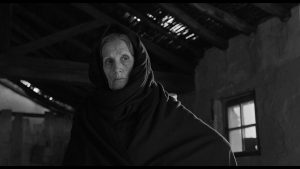
Isabel Ruth entered into a pact of silence. The script belongs to the director. The aesthetic choices are the director’s. The character fulfills narrative demands but the looks, the posture of the body, the duration and the intensity of the silences are Isabel Ruth’s choice.
Through the silences, we have the illusion of entering the creative universe of a Woman!
Thank you for your silences, Isabel Ruth!
Anabela Moreira